
Disclaimer: Some sections of this blog, specifically the overview of all the recommendations, use direct language from the final recommendations report to ensure clarity and accuracy for our readers. All credit for the recommendations and the specific language used goes to the hardworking members of the Sussex County Land Use Reform Working Group and any contributors to the meetings themselves.
The Sussex County Land Use Reform Working Group officially concluded its work in 2025 after months of discussion, public meetings, and policy review focused on how the county should and how they currently manage growth and development in our area.
Following its final meeting on September 11th, the group released a final report and a recommendations presentation in October outlining their final 20 proposed changes that the group concluded upon that are intended to help shape future land use decisions, zoning practices, and infrastructure planning in Sussex County.
Background and Purpose
The Land Use Reform Working Group was created by the Sussex County Council in early 2025 in response to increasing concerns about rapid development, housing affordability, infrastructure capacity, and the long-term preservation of farmland and natural resources.
The group was tasked with reviewing existing land use policies and identifying potential reforms that could be incorporated into the County Code and future Comprehensive Plan updates.
Its stated goals included directing growth to areas with existing or planned infrastructure, expanding housing options, particularly workforce and affordable housing, reducing sprawl, and improving predictability and transparency in land use decisions.
The working group included representatives with experience in development, agriculture, transportation, environmental protection, and housing.
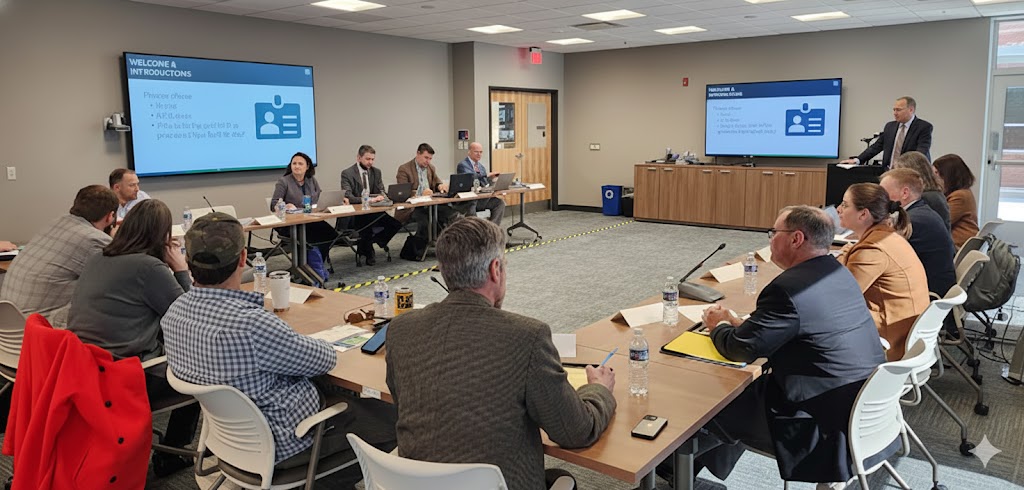
Image Generated by AI
Process and Final Meeting
Between March and September 2025, the working group held a series of long, in depth, open to the public meetings to evaluate land use challenges and debate possible policy solutions.
These discussions covered topics such as zoning consistency, density, housing types, transportation coordination, environmental protection, and subdivision design. All of their discussions are recorded and can be watched at any time here.
The final meeting took place on September 11th, 2025, when members reviewed and voted on a final package of 20 recommendations.
The recommendations were approved as a unified set and forwarded to the Sussex County Council for consideration.
The group emphasized that many of the proposals are interconnected and intended to work together rather than as standalone changes.
Overview of Recommendations
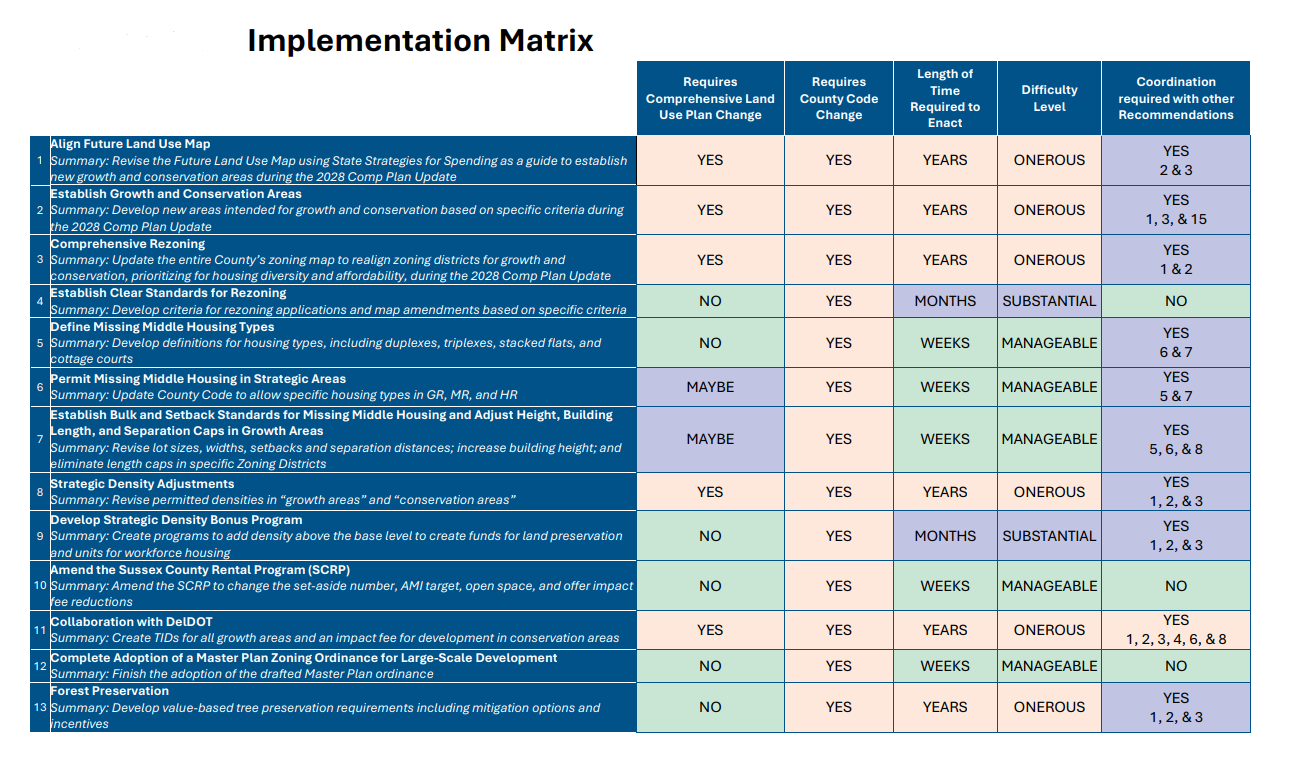
The working group’s recommendations focus on updating land use policy to better manage growth, improve housing availability, and protect rural and environmental areas, with many proposals tied to future Comprehensive Plan updates and zoning changes.
1. Align Future Land Use Map
Update the Future Land Use Map for the 2028 Comprehensive Plan by applying State Strategies for Spending. Use these guidelines to establish clear boundaries for both Growth and Conservation Areas where applicable.
For more information & background discussion on this recommendation, you can read further on page 6 of the final recommendations report.
2. Establish Growth and Conservation Areas
During the next Comprehensive Plan update, establish Growth Areas and Conservation Areas to align development with infrastructure and land suitability.
Growth Areas would replace existing plan designations and be based on access to sewer and water, proximity to municipalities, major roadways, services, transit, and existing growth patterns, while including transition zones at their edges.
All remaining areas would be designated as Conservation Areas to limit sprawl, preserve farmland, protect natural resources, and restrict development where infrastructure is limited, with zoning districts limited accordingly in each area.
For more information & background discussion on this recommendation, you can read further on page 7 of the final recommendations report.
3. Comprehensive Rezoning
As part of the 2028 Comprehensive Plan update, conduct a countywide rezoning to align zoning districts with the newly established Growth and Conservation Areas, prioritizing housing diversity and affordability and supported by public engagement and implementation guidance.
For more information & background discussion on this recommendation, you can read further on page 8 of the final recommendations report.
4. Establish Clear Standards for Rezoning
Adopt codified, transparent criteria for evaluating rezoning applications, including consistency with the Comprehensive Plan, compatibility with zoning intent, environmental suitability, and proximity to existing or planned infrastructure.
For more information & background discussion on this recommendation, you can read further on page 9 of the final recommendations report.
5. Define Missing Middle Housing Types
Amend the Zoning Code to clearly define Missing Middle Housing types, such as duplexes, triplexes, stacked flats, and cottage courts, separating them from the broader “multifamily” category by revising existing definitions and adding new, specific housing definitions.
For more information & background discussion on this recommendation, you can read further on page 10 of the final recommendations report.
6. Permit Missing Middle Housing in Strategic Areas
Update zoning regulations in GR, MR, and HR districts to allow a broader range of housing types within designated Growth Areas, including duplexes, triplexes, townhomes, cottage courts, stacked flats, and multifamily buildings.
Additional adjustments potentially tied to future density bonus changes.
For more information & background discussion on this recommendation, you can read further on page 11 of the final recommendations report.
7. Establish Bulk and Setback Standards for Missing Middle Housing and adjust height, building length, and separation caps in growth areas
Revise lot size, width, setback, and separation standards in Growth Areas to enable compact housing types across multiple zoning districts.
Increase maximum building height to 60 feet for mixed-use and multifamily development, remove building length caps for townhomes and multifamily buildings, allow more than eight attached townhome units per building, and reduce separation between multifamily buildings to 20 feet.
For more information & background discussion on this recommendation, you can read further on page 12 of the final recommendations report.
8. Strategic Density Adjustments
Adjust base residential densities to promote growth in infrastructure-supported areas and limit development in conservation-focused areas by setting maximum densities of four units per acre in GR, six in MR, eighteen in HR, and one unit per acre in AR-1 zoning districts.
For more information & background discussion on this recommendation, you can read further on page 13 of the final recommendations report.
9. Develop Strategic Density Bonus Program
Expand the density bonus program to allow up to a one-third density increase in GR, MR, and HR zoning districts within Growth Areas only, tied to land preservation or workforce housing.
Replace flat per-unit fees with tiered fees based on unit type and direct proceeds to a dedicated land preservation fund.
Also, authorizing bonus density for workforce housing developments that set aside 10 percent of units at up to 120 percent of AMI.
For more information & background discussion on this recommendation, you can read further on page 14 of the final recommendations report.
10. Amend the Sussex County Rental Program (SCRP)
Revise the SCRP to improve participation by reducing the affordable unit requirement from 25 percent to 15 percent, increasing the affordability target from 50 percent to 80 percent AMI, lowering open space requirements, offering proportional impact fee reductions.
Also, align rent limits with HUD or applicable state and federal housing program standards.
For more information & background discussion on this recommendation, you can read further on page 15 of the final recommendations report.
11. Collaborate with Delaware Department of Transportation (DelDOT)
Work with DelDOT to create Transportation Improvement Districts for all Growth Areas and develop a transportation impact fee for development located in Conservation Areas.
For more information & background discussion on this recommendation, you can read further on page 16 of the final recommendations report.
12. Complete Adoption of a Master Plan Zoning Ordinance for Large-Scale Development
Finalize adoption of the drafted Master Plan Zone ordinance to support coordinated, mixed-use, and infrastructure-aligned large-scale development through a phased process consistent with the Comprehensive Plan.
For more information & background discussion on this recommendation, you can read further on page 17 of the final recommendations report.
13. Forest Preservation
Promote retention of existing trees through value-based preservation standards, mitigation requirements, and incentives.
Set minimum retention percentages, 30% inside Growth Areas, 50% outside, and allow mitigation at defined ratios.
Establish landscape and tree planting requirements for residential and non-residential developments based on location and net developed area.
For more information & background discussion on this recommendation, you can read further on page 18 of the final recommendations report.
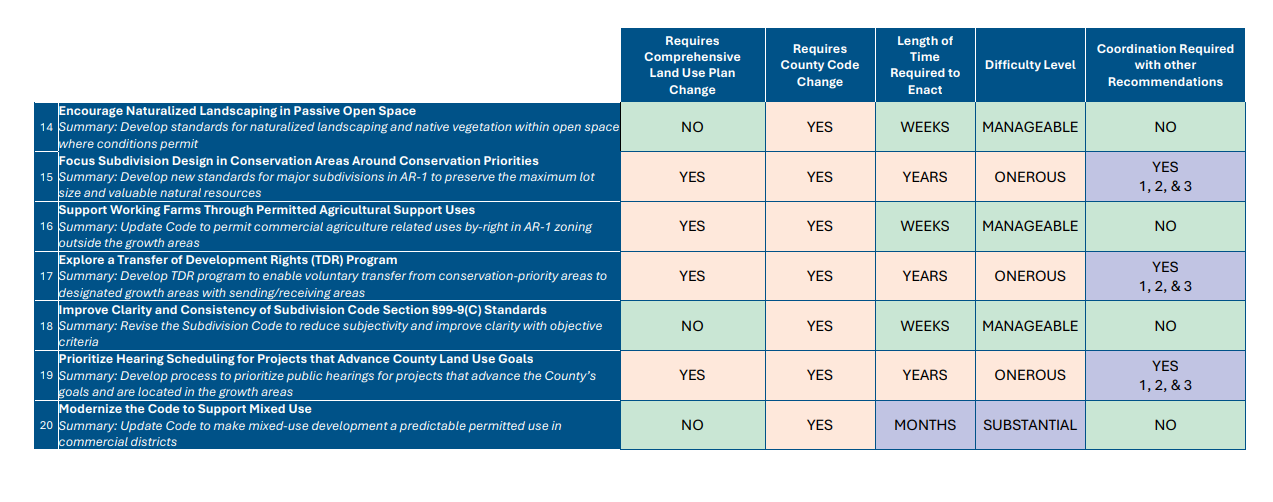
14. Encourage Naturalized Landscaping in Passive Open Space
Promote native and habitat-friendly landscaping in preserved open space, including pollinator zones and low-mow areas, coordinated with the Sussex Conservation District, while complementing state standards and site constraints.
For more information & background discussion on this recommendation, you can read further on page 20 of the final recommendations report.
15. Focus Subdivision Design Around Conservation Priorities
Require major subdivisions in AR-1 zoning within Conservation Areas to maximize preservation of natural resources.
Increase minimum open space to 35–50% and use resource mapping to prioritize protection of waterways, wetlands, forests, and wildlife habitat corridors.
For more information & background discussion on this recommendation, you can read further on page 21 of the final recommendations report.
16. Support Working Farms Through Permitted Agricultural Support Uses
Permit commercial agricultural support uses by right in AR-1 areas outside Growth Areas, such as processing facilities and equipment repair, and revise outdated zoning procedures that duplicate state oversight.
For more information & background discussion on this recommendation, you can read further on page 22 of the final recommendations report.
17. Explore a Transfer of Development Rights (TDR) Program
Review the feasibility of a voluntary TDR program to shift development rights from conservation-priority areas to designated Growth Areas with clearly defined sending and receiving zones.
For more information & background discussion on this recommendation, you can read further on page 23 of the final recommendations report.
18. Improve Clarity and Consistency of Subdivision Code Section §99-9(C) Standards
Revise the subdivision code to reduce subjectivity and provide objective, measurable criteria for review.
Remove ambiguous terms and reference relevant County codes and technical guidance to improve consistency and transparency.
For more information & background discussion on this recommendation, you can read further on page 24 of the final recommendations report.
19. Prioritize Hearing Scheduling for Projects That Advance County Land Use Goals
Develop a prioritization framework for public hearings that favors projects supporting Growth Area objectives and housing variety. This process will emphasize infrastructure coordination without bypassing essential public hearing mandates.
Standardize review for frequently recurring non-residential projects to reduce backlogs.
For more information & background discussion on this recommendation, you can read further on page 25 of the final recommendations report.
20. Modernize the Code to Support Mixed Use
Update zoning regulations to make mixed-use development a predictable permitted use in commercial districts, with flexible height, density, and parking standards, while requiring transitions and buffering to protect adjacent low-density neighborhoods.
Together, the recommendations outline a framework intended to guide growth toward infrastructure-ready areas, expand housing options, and strengthen land and environmental protections across Sussex County.
For more information & background discussion on this recommendation, you can read further on page 26 of the final recommendations report.
Next Steps
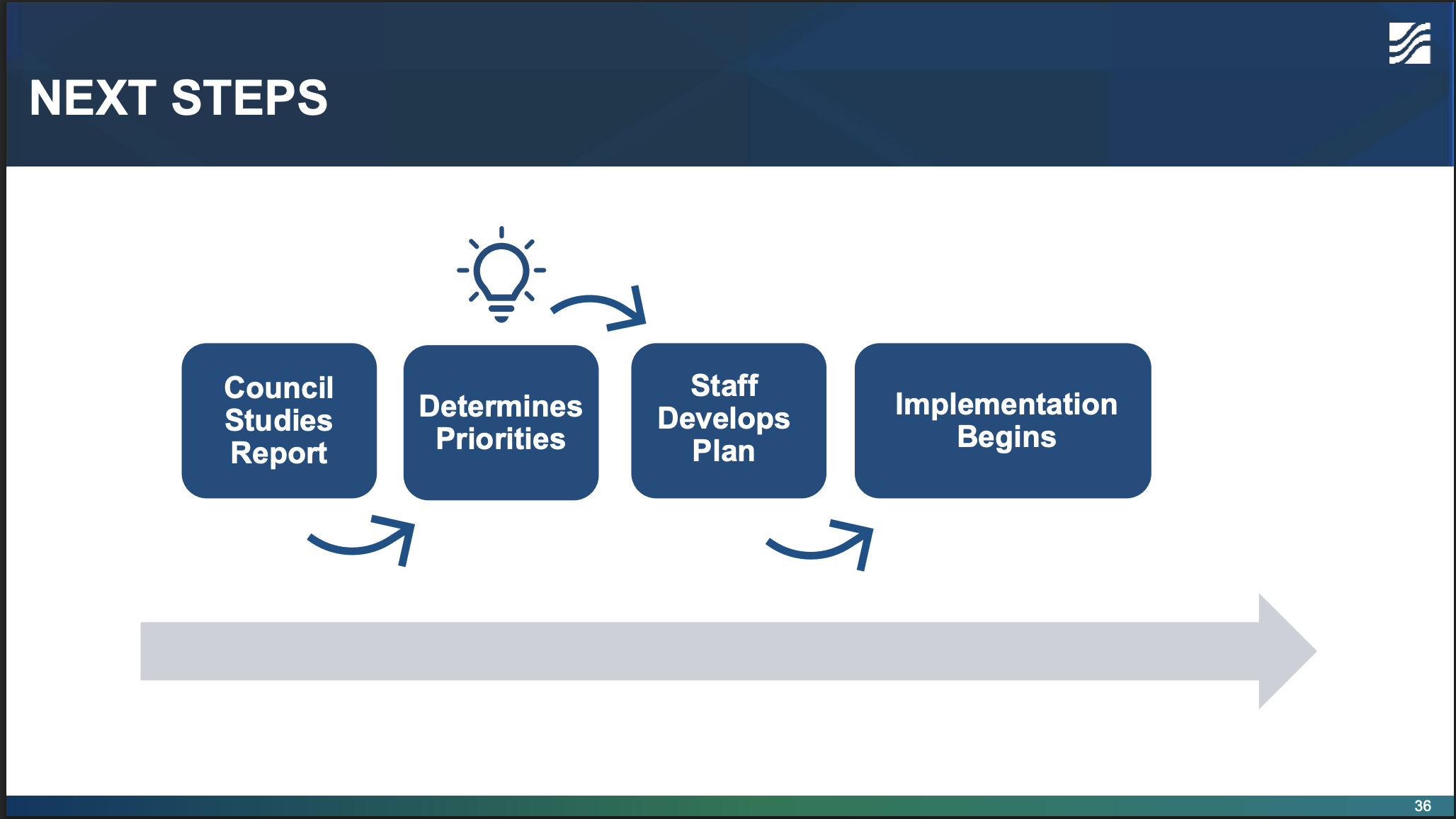
With the release of the Final Report and Recommendations Presentation in October 2025, the Sussex County Council assumed responsibility for reviewing and determining how, and whether, to implement the proposed changes.
Some recommendations may move forward through ordinance amendments or policy updates, while others are expected to be addressed as part of the county’s upcoming Comprehensive Plan update.
County officials have indicated that implementation will likely occur in phases, with certain items requiring additional public input, technical analysis, or coordination with state agencies before adoption.
Sources: Meeting Summary September 11, 2025, Final Recommendations, Recommendations Presentation, Final Report
Check out this article next